Decoding IT project manager interview questions: what interviewers really listen for (and why you don't need every technical answer)

Behind every tech PM interview question is a second question the interviewer's actually asking. Here's how to spot it — plus what the UK’s new PM Andy Burnham can teach you before you walk in, and why to beware the rabbit hole.
Users of Free-Work and other technology job candidates do not need to know EVERY technical detail to crack an IT project manager interview in 2026-27. But you absolutely need to know WHAT is actually being tested for!
Following my 74-question IT Project Manager (PM) interview guide, I'll draw here on my 22 years in tech operations and leadership to decode what the gatekeepers of PM tech jobs are really listening for in their ten most-asked questions — and pinpoint how to angle your answers successfully, writes Glenn Richardson, platform and service operations manager at CV-Library
Here are the key takeaways — for any IT PM job-hopefuls whose interview is minutes away, not months:
Key takeaways
IT project manager interviews are usually delivery-focused, not technical: interviewers care more about how you manage people, risk and change than whether you can configure a system yourself.
You're not expected to know every technical detail. What matters is knowing how to ask the right questions, involve the right people, and keep decisions moving.
Every question at an IT project manager job interview is really testing something underneath the surface — the table below decodes ten common questions + interviewer intents, showing what's being assessed and how to angle a strong answer.
Tech project manager interviewers listen closely for whether your CV claims (e.g. ‘leadership,’ or ‘analytical thinking’) are backed by real examples — fellow tech recruiter Matt Collingwood, of VIQU IT, calls this "CV Word-Bingo," and it can catch out aspiring PMs.
When you're asked to explain project data — a budget variance, a slipped milestone — the number alone isn't the answer. As Sophie Twose, of data, technology and transformation firm CACI puts it, "Data without context... points you at the wrong problem and solution entirely."
Preparation for an IT project manager interview in 2026-27 comes down to seven practical steps, plus a small number of STAR-method examples you can adapt on the spot.
What are IT project manager interviewers actually testing for?

The interviewer is testing for your PROCESS. Therefore, stay calm, structure your answer and explain your assumptions.
A strong answer to a fair chunk of the queries posed during a technology project manager job interview revolves around you clearly demonstrating that you can balance control with flexibility. After all, IT projects are prone to change, notably when requirements become clearer or receive approval, when technical issues emerge, or if business priorities shift.
Whoever's hiring wants to see that you can adapt without losing sight of a project's objectives.
Do I need to know every technical detail to crack an IT PM interview?
No, if you don't know a technical detail, don't pretend.
In IT project management, you are not expected to be the developer, architect, tester and security specialist all at once!
What matters is that you know how to ask the right questions, involve the right people and make sure decisions are properly understood.
What's the difference between a PM interview question and what it's actually testing?
Most IT project manager job interview questions have two layers: the question itself, and the underlying trait it's designed to surface. A question like "How do you manage risks?" isn't really about risk registers — it's testing project control. "What's your experience with Agile?" isn't really about ceremonies — it's testing delivery knowledge.
Decoding that second layer is what separates a technically correct answer from a genuinely strong one:
Example IT project manager interview questions and strong answer angles
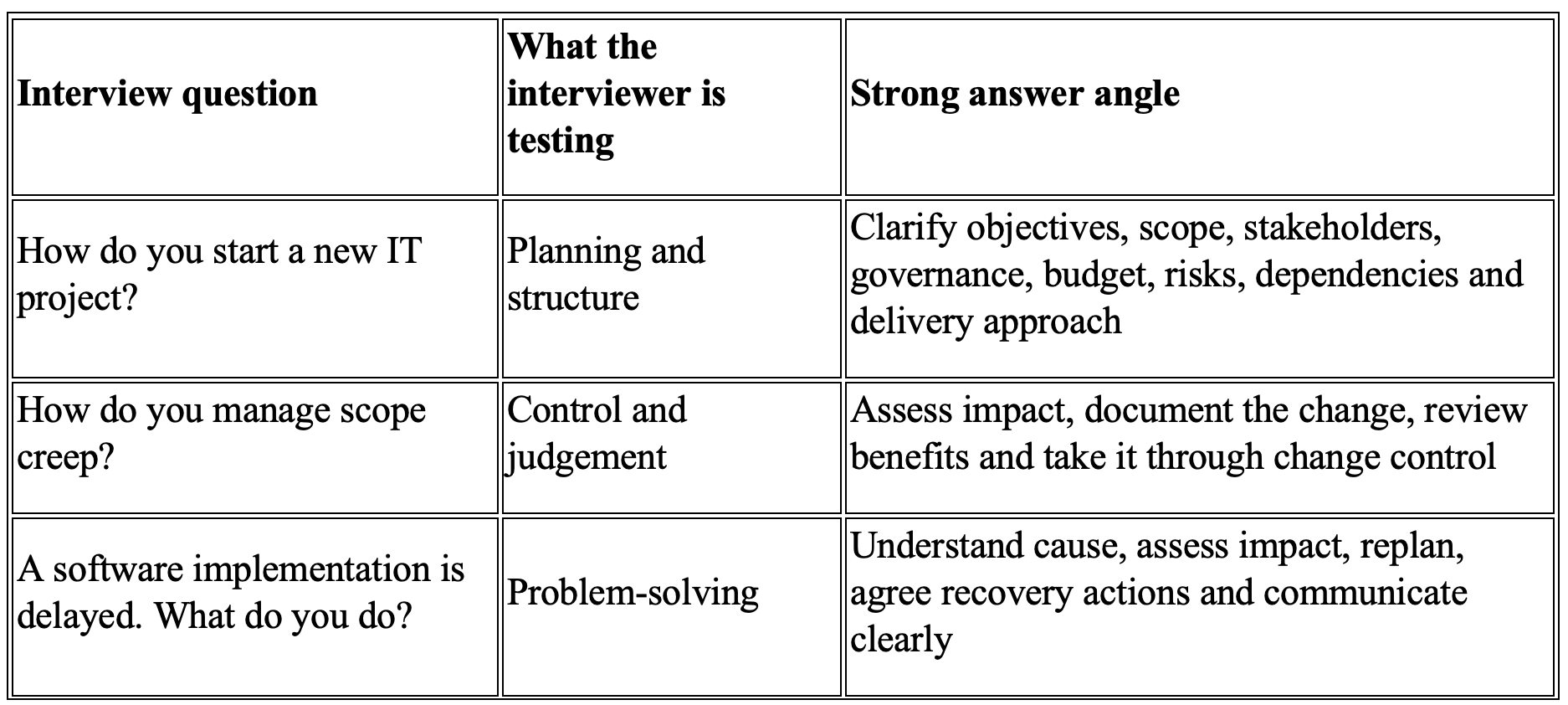
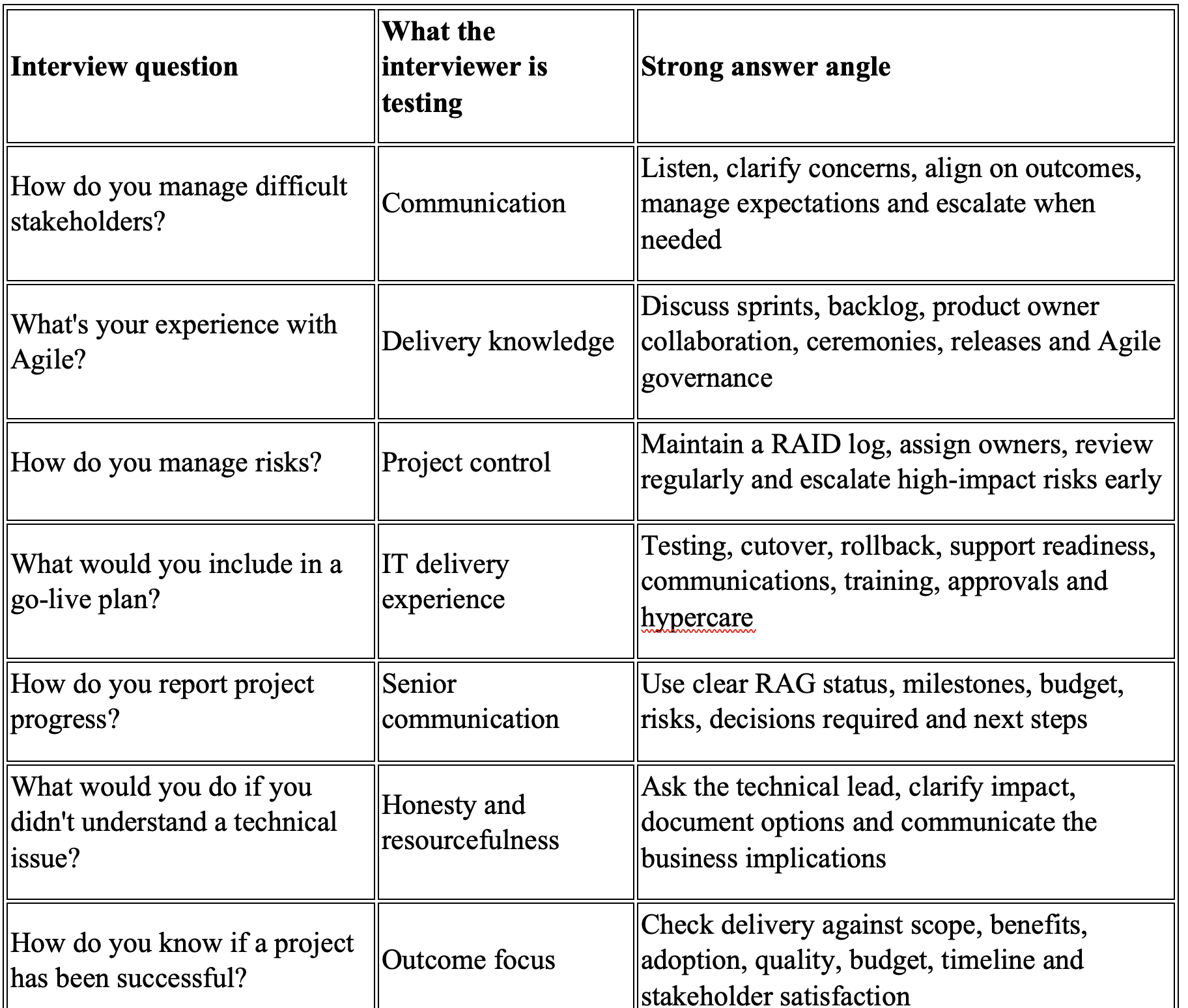
Does context trump data in a project management interview answer?

Yes, context beats a raw number every time. Reporting progress well (the "senior communication" row in the table above) isn't about having the RAG status and budget figures ready; it's about being able to explain what they mean, in the round. Interviewers aren't checking that you can produce a number; they're checking whether you understand it.
Popping up on my LinkedIn feed, Sophie Twose, who is an associate director at technology consulting, data and transformation firm CACI, sounds alive to context mattering more than data alone.
Referencing Andy Burnham becoming UK prime minister on July 20th 2026, Twose posted:
“Early this morning, hours before becoming Prime Minister, Andy Burnham gave an interview from a homeless shelter. He faced some difficult questions about his mission to end homelessness, and it's a perfect example of why context matters more than data alone. Look at the raw data from Andy's time as Mayor and the figures show homelessness going up. Mission failed? Not quite.
“The context: his 'A Bed Every Night' scheme was so effective at getting people off the streets that people experiencing homelessness travelled from across the country to access the support Greater Manchester offered. The local figures rose because the initiative worked so successfully. Whether you're a fan of Burnham or not, the lesson stands. Data without context doesn't just mislead you. It points you at the wrong problem and solution entirely.”
What can the Andy Burnham anecdote teach PM job candidates?
Lead with the reasoning, not the number. If you're asked in a job interview about a project that ran over budget or slipped its timeline, the figure on its own isn't the answer — the context is what changed, why that decision was made, and what it protected or achieved.
Are buzzwords good to include at an IT project manager interview?
No, avoid buzzwords, especially buzzwords about yourself that you cannot evidence — as that’s one of the fastest ways that an otherwise strong project manager candidate for a tech role can come unstuck.
As fellow IT recruiter Matt Collingwood, managing director at VIQU IT, put it in a recent LinkedIn post:
"A good interviewer will have read your CV before you walk into the room. They'll have picked up on the words you've used to describe yourself too. Natural leader. Innovator. Team player. Analytical thinker. Entrepreneur. Whatever you've chosen to put on there, expect to be asked about it.
“If you say you’re a natural leader, be ready to tell me about a specific time you led people. If you say you’re analytical, tell me where you’ve used that skill and the outcome. You’d be amazed how many people can’t answer those questions when speaking about an alleged strength. They just freeze. It’s like a rabbit in the headlights because more often than not, they’re playing CV word-bingo.”
How should I prepare for an IT project manager interview?

Before your tech PM job interview, make sure you:
Review the job description and identify the type of projects involved, such as software delivery, infrastructure, cloud migration, ERP, CRM, cybersecurity, data, digital transformation or business change.
Prepare examples of projects you've delivered, including scope, budget, timeline, team size, challenges and outcomes.
Refresh your knowledge of Agile, Waterfall and hybrid delivery.
Practise explaining how you manage risks, issues, dependencies, change control and governance.
Prepare examples of stakeholder management, especially difficult or senior stakeholders.
Review common IT project stages, including requirements, design, build, testing, UAT, deployment, go-live and hypercare.
Prepare questions about the organisation's delivery model, project governance, team structure, tools, technical environment and current project portfolio.
What's the STAR method, and why does it matter for a PM interview?
Before an employer grills you about your suitability to be their IT project manager, it's also worth preparing a few concise success stories or case studies using the STAR method.
STAR stands for:
Situation
Task
Action
Result
What measurable outcomes can IT project managers talk about at interview?
The six measurable outcomes that employers of technology project managers want to hear about in 2026-27 are:
Reduced delays
Improved delivery confidence
Controlled costs
Increased adoption
Successful go-live
Improved stakeholder satisfaction.
Use these to strengthen the Result part of your STAR-structured case study.
What to NOT do during a tech project manager job interview?
Don't go down a rabbit hole. Whether you're interviewing at a start-up, a big corporate, or an NGO, the IT project manager role is broad — and across 74 possible questions, it's easy to get sidetracked chasing less-important detail.
The fix: know the role you're applying for, and you'll know what actually matters to the end-hirer. If you feel yourself heading down a rabbit hole, take your cue from the interviewer and steer back to what matters to the employer.
The takeaway
To really prepare well, practise talking through real project examples and rehearsing your answers out loud.
Focus on your process, your decisions and the outcomes you achieved. Remember, IT project management isn't about knowing every technical answer. It's about asking the right questions, bringing the right people together and making sure the project delivers value for the business.
Editor’s Note: For the full rundown of 74 likely interview questions across all twelve topic areas, see Glenn’s guide, exclusively for Free-Work: IT project manager interview guide: 74 questions and model answers.
Written by
Glenn Richardson
Glenn Richardson is the Platform & Service Operations Manager at CV-Library. He is responsible for the reliability, security, and day-to-day operations of the CV-Library estate, including keeping the platform running and delivering services to its many users. Glenn began his career in the Armed Forces as a Reconnaissance Operator, delivering critical intelligence to senior officers. The transition into IT felt like a natural progression - both worlds demand precision, problem-solving under pressure, and the ability to find clarity in complex information. He started out in technical support for an ISP and grew from there into datacentre infrastructure engineering, taking ownership of datacentre presence at each company he has worked for since. Over 22 years, Glenn has built expertise across networking, virtualisation, databases, and security - and with the industry's shift toward cloud - he expanded that knowledge into AWS, leading successful datacentre migrations at his last two employers, including CV-Library, with no disruption to end users or the business. This same dedication to getting things right has shaped how Glenn approaches leadership. At CV-Library, Glenn has taken what was a traditional service delivery function and built it into a modern Platform & Service Operations discipline - one that goes beyond keeping the lights on, embedding reliability, security, and engineering excellence into the foundations of how the technology organisation operates and grows.




Comment
Log in or create your account to react to the article.